10 -
General information on the fuel injection-ignition system
Integrated electronically-controlled ignition and injection controlled by just one control unit ensure optimal Otto cycle engine performance and output, thus reducing consumption and harmful substances into the exhaust gas. This system ensures an accurately metered air-fuel ratio and optimal management of ignition advance.
 
This system consists of three different circuits:
Fuel circuit
Intake air circuit
Electric circuit (featuring control unit, sensors and actuators).
Importance of the air-fuel ratio and the ignition advance
Correct management of the air-fuel ratio and of the ignition advance are fundamental for optimal engine operation.
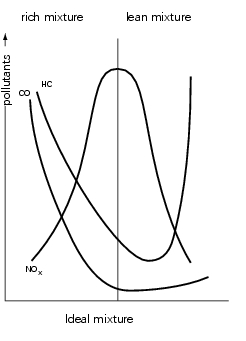
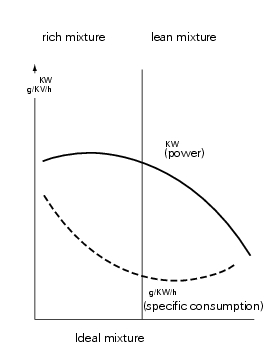
The air-fuel ratio is given by the ratio, in weight, of air and fuel taken in by the engine: the ideal or stoichiometric ratio is that which establishes complete combustion. Excessive air or insufficient air give rise to, respectively, a lean (or weak) mixture or a rich mixture, which affect power and consumption, as well as emissions of exhaust gases.
Electronic control of ignition timing advance makes it possible to optimise the performance of the engine, maximum power output, fuel consumption and the concentration of exhaust pollutants.
Electronic ignition timing control combined with fuel supply control allows for optimal engine operation in all conditions of use (low temperature start, warm-up stage, transitory acceleration/deceleration stages, engine under partial load, full load, idle).
Siemens M3C injection-ignition system
The Siemens M3C injection-ignition system is the Alfa/N type, in which the engine speed and throttle position are used as main parameters for measuring the quantity of intake air. If the quantity of air is known, the quantity of fuel can be dosed accordingly to obtain the required ratio. Other sensors in the system (engine sensor, intake air pressure, air temperature, engine temperature and lambda sensor for CO control) allow corrections to the basic management strategy to suit specific operating conditions. The engine speed and the throttle angle also make it possible to calculate the optimal advance for all types of operating conditions. The quantity of air taken in by each cylinder during each cycle depends on the density of the air in the intake manifold, the cylinder capacity and the volumetric efficiency.
Volumetric efficiency is experimentally taken onto the engine in the whole operating range (rotation speed and engine load conditions). Taken values are then used for the generation of a map which is stored into the Flash Eprom of the Siemens M3C ECU, for injection control. The Flash Eprom can be programmed via CAN line. Fuel injection control is of the phased sequential type, i.e. the injectors are not operated in parallel. Fuel delivery to each cylinder can be started from the expansion stage up to the intake stage, already in progress. Fuel cut-off timing (the time when the injectors are closed), is saved in a special map, which is stored in the ECU Flash Eprom. Ignition is of the static inductive discharge type, featuring dwell time control so as to ensure coil charging at steady power. The power modules for the coil power supply are incorporated in the ECU hardware, while ignition advance curves are always stored in the Flash Eprom. Both coils and power modules are controlled by the ECU, which processes ignition advance.
Note
To check the injection-ignition system components and wiring use the “DDS” tester, as explained under “Guided diagnosis” (Sect. 6 - 13).
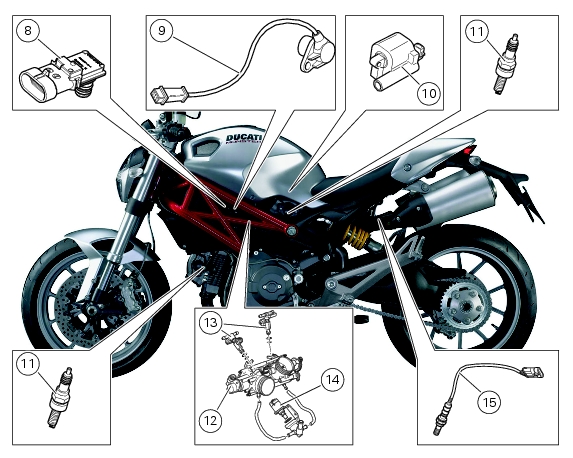
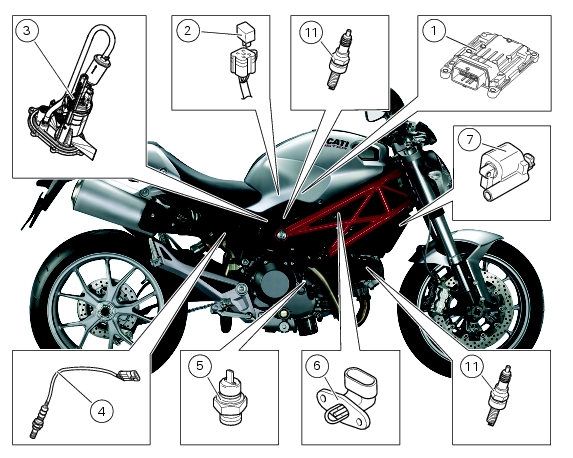
Sensor positioning diagram
1
2
3
4
5
6
7
8
9
10
11
12
13
14
15
Fuel circuit
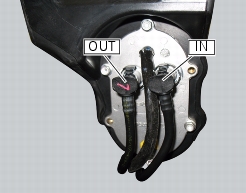
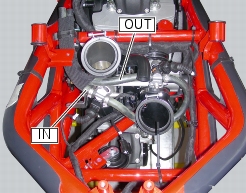
A pump located on a flange at the bottom of fuel tank pumps fuel into delivery tube (OUT) and toward injectors. The flange also fits the pressure regulator controlling fuel feed and keeping it constant at a value higher than engine-generated vacuum. Fuel that is not injected in the intake hoses returns to the flange and then to the tank by way of a return hose (IN).
Intake air circuit
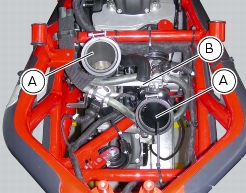
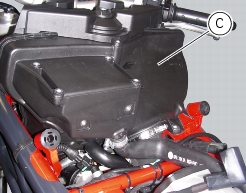
The air circuit consists of two intake ducts (A), a throttle body (B) and an intake air box (C) (airbox) above the throttle body.
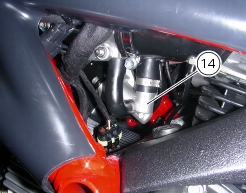
This motorcycle is also equipped with a stepper motor (14) that defines the magnitude of the supply of supplementary air, down-line from the throttles, during the engine starting phase (see “Operating phases” in this section).
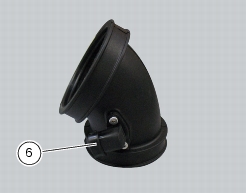
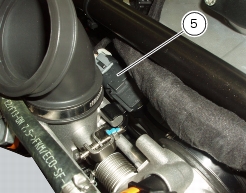
The engine control system (ignition and injection) relies on several sensors which correct mixture strength according to air pressure and temperature and engine load. An air temperature sensor (6) located on the intake manifold of the vertical cylinder and an air pressure sensor (5) located between the “V” of the engine block, connected to the air intakes, measures the atmospheric pressure and transmits this information to the ECU where it used to make essential adjustments to the quantity of fuel injected when the motorcycle is ridden at varying altitudes (e.g. a route that starts at sea level and ends at a high altitude); The ECU also uses this information to adjust the air/fuel ratio according to air density. (Assuming that the volume of air remains constant, an increase in temperature will lead to a decrease in the air density and consequently a reduced oxygen content, whereas a fall in temperature will cause an increase in air density and consequently the oxygen content will rise.
When the temperature is higher, the mixture should be leaner, while if it is lower the mixture should be richer to obtain the best air-fuel ratio).
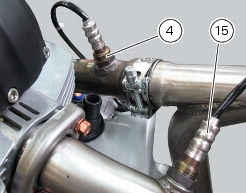
The exhaust pipes of horizontal and vertical cylinder are equipped with two lambda sensors (4), (15), which transmit information to the air-fuel mixture control system.
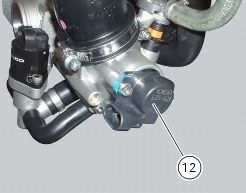
There is a throttle position sensor (12) fitted on the shaft of the throttle of the rear cylinder. This device sends the ECU a signal that is an indirect indication of the quantity of air drawn in by the engine (indirect measurement of engine load).
Operating phases
Normal operation
When the engine is fully warm, the control unit calculates injection time and ignition advance, by comparing the stored map values, in accordance with the RPM and throttle position. The calculated quantity of fuel is fed through injectors in one single sequential delivery to the two cylinders, during the useful cycle.
Starting
When the ignition switch is turned to ON, the control unit feeds the fuel pump for a few moments to put fuel feed hydraulic circuit under pressure. It receives and processes the throttle position and engine temperature signals. When the engine is started, the unit receives the engine RPM and timing signals that allow it to proceed with injection and ignition. To facilitate start-up, the basic mixture is made richer in accordance with the engine temperature. During starting, the ignition advance is fixed (0°) until the engine starts. When the engine starts, the ECU controls the ignition advance in accordance with the values stored in the map and makes any necessary corrections according to the air and engine temperatures.
Acceleration/deceleration
During acceleration, the ECU makes the mixture richer for improved engine performance. Acceleration is detected by monitoring the speed at which the rider turns the twistgrip to open the throttle. During a rapid deceleration, determined by the rider quickly turning the twistgrip to close the throttle, the ECU makes the mixture leaner to reduce emissions and fuel consumption.