8 -
1
2
3
4
5
6
7
8
9
10
11
12
13
14
15
16
17
18
19
20
21
22
23
24
25
26
27
28
29
30
31
32
33
34
35
36
37
38
39
40
41
42
43
44
45
46
47
48
 Spare parts catalogue
Important
Bold reference numbers in this section identify parts not shown in the figures alongside the text, but which can be found in the exploded view diagram.
Operating principle of the catalytic converter
This model is fitted with “three-way” catalytic converters. Catalytic converters are fitted to the exhaust system in order to eliminate the noxious substances found in exhaust fumes, namely CO (carbon monoxide), HC (unburnt hydrocarbons) and NOx (nitric oxide). The catalytic converter has a special honeycomb support, coated with aluminium oxide, which creates an irregular surface thus increasing the surface area exposed to exhaust gas. The aluminium oxide is coated with activated substances that help to remove harmful components of exhaust emissions. These substances are usually platinum and rhodium. Platinum allows the oxidation (combination with oxygen) of CO and HC. Rhodium allows the reduction (combination with CO) of NOx contents. To ensure that CO and HC components can oxidise to form water and carbon dioxide and that NOx contents can be reduced by forming nitrogen and carbon dioxide, there must be a precise amount of oxygen in the exhaust gas. For this reason it is essential that the air-fuel mixture is correctly proportioned. This result has been achieved thanks to the use of a sophisticated fuel system designed to meter the air-fuel mixture with absolute precision.
The lambda sensor (Sect. 6 - 8) monitors the oxygen content of exhaust fumes and transmits the relative data instantaneously to the ECU. The control unit (through injection) keeps the air-fuel ratio as close as possible to optimum value (with a certain tolerance) in order to ensure top performance of the catalytic converters in the exhaust pipes. In terms of emissions, this means achieving minimum hydrocarbon (HC) and carbon monoxide (CO) emissions as well as minimum nitrogen oxide (NOX) emissions. The 3 way catalytic converters complete the exhaust fumes cleaning process by converting residues of CO, HC and NOX in the exhaust gas, thus ensuring exhaust emissions comply with EURO 3 regulations.
How to ensure that the catalytic converter functions correctly
In order to function correctly, the catalytic converter must reach a temperature of around 800 °C and never fall below 300 °C. The indicated maximum temperature must not be exceeded, otherwise the catalytic converter could be irreparably damaged. For this reason, it is essential that significant quantities of unburnt fuel do not accumulate in the exhaust gas post-treatment element, since these would otherwise burn resulting in a sharp increase in temperature. This is why the ignition-injection system should always be in perfect working order (misfiring is not acceptable). Moreover, never push-start the motorcycle (with key and ENGINE STOP button set to ON). In this instance, if the engine does not start, any unburnt fuel would enter the exhaust system and stay in the catalytic converters. Motorcycles fitted with catalytic converters must be used exclusively with unleaded petrol. Otherwise the lead content of petrol would deposit on the activated substances and limit their action against the harmful components of exhaust gas.
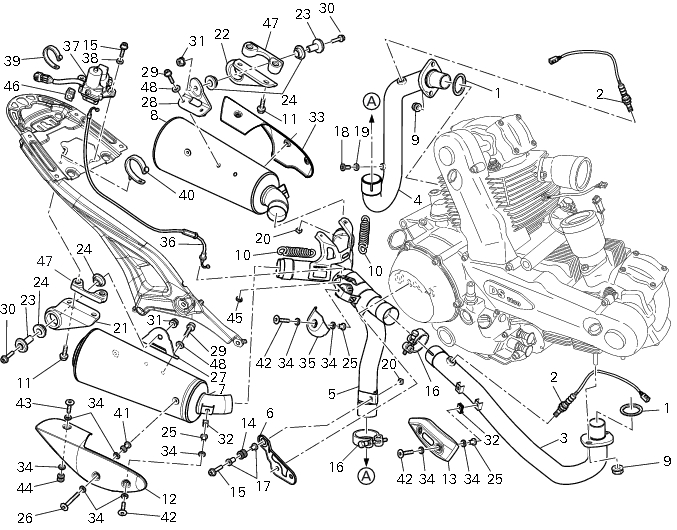
Removal of the exhaust system
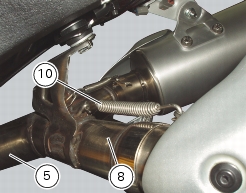
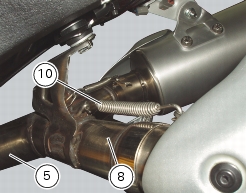
Remove the retaining spring (10) of the LH silencer (8) from the centre exhaust pipe (5).
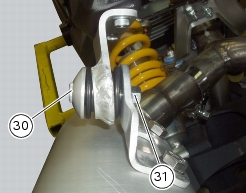
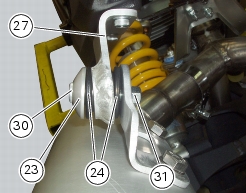
While holding the nut (31), unscrew the retaining screw (30) and remove the LH silencer (8) from the motorcycle.
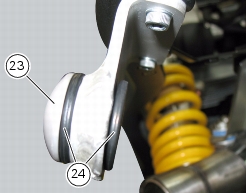
Recover the spacer (23) and the rubber bushes (24).
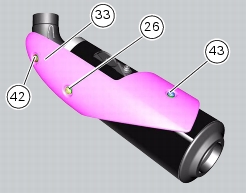
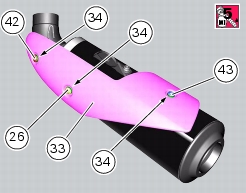
Remove the left-hand side heat shield (33) loosening screws (26), (42) and (43); recover the spacers (25), (41) and (44) and the washers (34).
Follow the same procedure to remove the RH silencer (7).
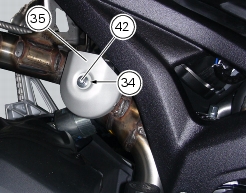
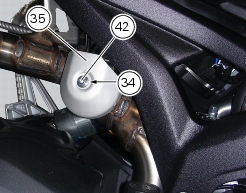
Remove the protection (35), loosening the screw (42) and recovering the washers (34) and the spacer (25).
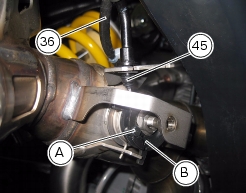
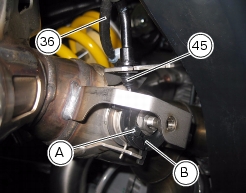
Release the end fitting (A) of the cable (36) from the exhaust valve (B) and remove the circlip (45).
Remove the cable (36) from the exhaust valve (B).
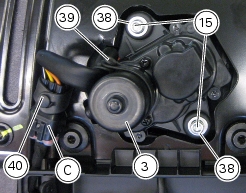
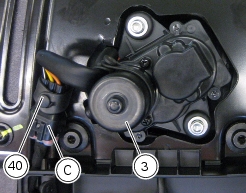
Remove the clamps (39), (40) and disconnect the exhaust valve motor wiring (C).
Unscrew the bolts (15) and remove the exhaust valve motor (37) from the rear number plate holder.
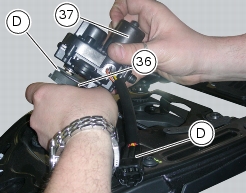
Remove the clip (46) and the cable (36) from the exhaust valve motor (37), sliding off the end fitting (D) from its seat.
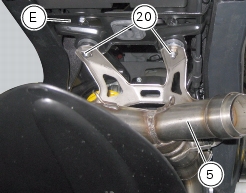
Loosen the two nuts (20) and take central exhaust pipe (5) off the mounting bracket for tank and exhaust (E).
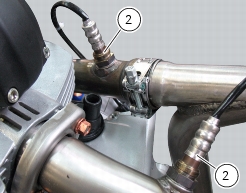
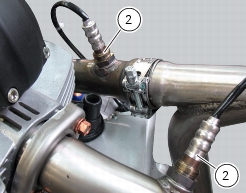
Disconnect the two lambda sensors (2) from the main wiring harness (Sect. 6 - 1, Routing of wiring on frame). Refer to
Section 6 - 12, Lambda sensor for details on lambda sensor.
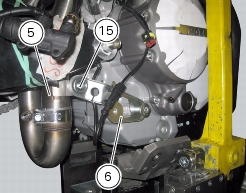
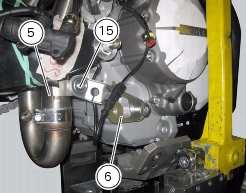
Unscrew the screw (15) retaining the central exhaust pipe (5) to engine and remove the bottom plate (6).
Unscrew the clamp (16) and separate the centre exhaust pipe (5) from the horizontal cylinder exhaust pipe (3) and the vertical cylinder exhaust pipe (4).
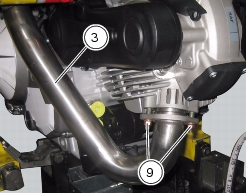
Loosen and remove the nuts (9) securing the exhaust pipe flanges to the cylinder heads.
Remove the flanges from the cylinder heads.
Slide out horizontal exhaust pipe (3) from horizontal head; recover the gasket (1).
Remove the vertical exhaust pipe (4) from the vertical cylinder head, recovering the gasket (1).
Important
Block off the exhaust ports on the head to prevent foreign matter from entering the combustion chamber.
 
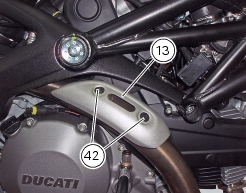
Loosen the screws (42) and remove the horizontal heat shield (13); recover the spacers (25) and the washers (34).
Refitting the exhaust system
Renew the gaskets (1).
Refit the horizontal exhaust pipe (3) and the vertical exhaust pipe (4) on the cylinder heads, starting the nuts (9) in their threads.
To tighten the nuts (9) execute the following operations.
Note
The text “right“ and “left“ refer to the direction of travel.
 
Tighten initially to a torque of 6 Nm ±10% (Sect. 3 - 3, Frame torque settings) in the following order:
-
-
-
-
Tighten to a torque of 24 Nm ±10% (Sect. 3 - 3, Frame torque settings) in the following order:
-
-
-
-
Check that the quick-release fasteners (32) are installed on the horizontal cylinder exhaust pipe (3).
Refit the horizontal heat shield (13) securing it with the retaining screws (42), the spacers (25) and the washers (34).
Tighten the screws (42) to a torque of 8 Nm ±10% (Sect. 3 - 3, Frame torque settings).
Refit the bottom plate (6) fitting and tightening the screw (15) to a torque of 5 Nm ±10% (Sect. 3 - 3, Frame torque settings).
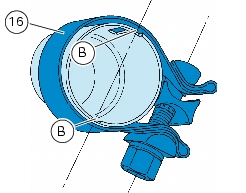
Insert the centre exhaust pipe (5) in the horizontal cylinder exhaust pipe (3) and vertical cylinder exhaust pipe (4) and secure with the clamps (16).
Position the clamps (16) as shown in the figure.
Position the clamps (16) so they are flush with the end of the exhaust pipes, or at least so that the notches (B) are not completely uncovered.
Tighten the clamps (16) to the specified torque (Sect. 3 - 3, Frame torque settings).
Refit the cable (36) on the exhaust valve motor (37) inserting the end fitting (D) in the pulley hole.
Fix the cable (36) with the clip (46).
Refit the cable (36) inserting the end fitting (A) on the exhaust valve (B) and secure it with the circlip (45).
Adjust cable (36) on exhaust valve and exhaust valve motor as explained under Sect. 4 - 3, Adjusting the exhaust valve bowden cable.
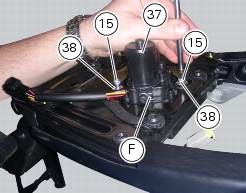
Set the exhaust valve motor (37) onto rear number plate holder, paying attention to position the spring (F) as shown. Insert the fixing screws (15) with washers (38). Tighten the screws (15) to a torque of 10 Nm ±10% (Sect. 3 - 3, Frame torque settings).
Fasten wiring (C) to exhaust valve motor central body using the rubber clamp (39) and ensuring that the cables coming out of motor do not touch the metal sheet sharp edge.
Connect the exhaust valve motor wiring (C) and fasten it with the clamp (40).
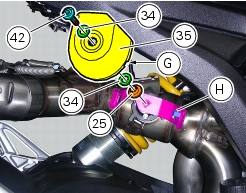
Refit the protection (35), starting the screw (42) with washers (34) and the spacer (25).
Note
When installing the protection (35), ensure that slot (G) matches the tab (H), as shown below.
Fasten the central exhaust pipe (5) to the mounting bracket of tank and exhaust (E) tightening the nuts (20) to a torque of 22 Nm ±10% (Sect. 3 - 3, Frame torque settings).
Connect the lambda sensors (2) to the main wiring harness (Sect. 6 - 1, Routing of wiring on frame).
Connect the silencer (8) to the centre exhaust pipe (5) and locate the springs (10).
If removed, install the two rubber bushes (24), positioning on either side of the silencer bracket (27).
Insert the spacer (23) in the silencer support bracket (27).
Move the silencer support brackets so that they rest against the footrest brackets.
Insert the screw (30) and, on the opposite side, fit the nut (31).
Tighten the screws (30) to a torque of 22 Nm ±10% (Sect. 3 - 3, Frame torque settings), while holding the nut (30).
Check that the quick-release fasteners (32) are installed on the LH silencer (8).
Fit the left-hand side heat shield (33) and install, in-between heat shield and exhaust silencer (8), the three washers (34) and the spacers (44) and (41), as shown in the figure.
 
Start the screws (42), (26) and (43) in their threads with the washers (34) onto left-hand side heat shield (33).
Tighten the screw (42) to a torque of 8 Nm ±10% and the screws (26) and (43) to a torque of 10 Nm ±10% (Sect. 3 - 3, Frame torque settings).
 
Follow the same procedure to refit the RH silencer (7).