13 -
1
2
3
4
5
6
7
8
9
10
11
12
13
14
15
16
17
18
19
20
21
22
23
24
25
26
27
28
29
30
31
32
33
34
35
36
37
38
39
40
 Spare parts catalogue
Important
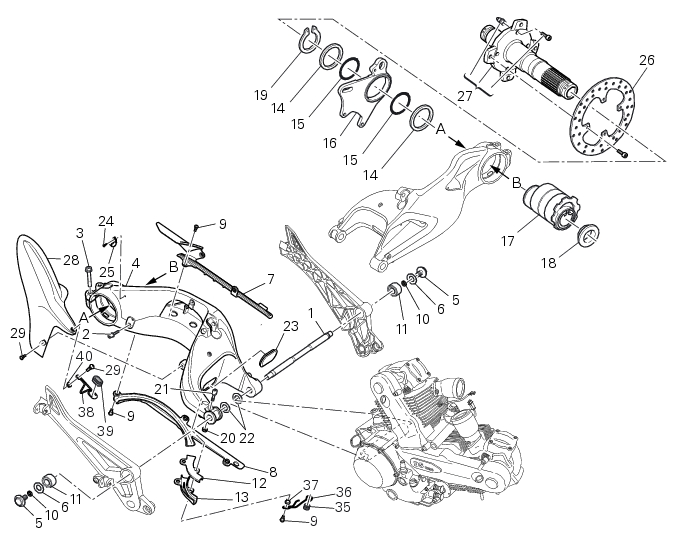
Bold reference numbers in this section identify parts not shown in the figures alongside the text, but which can be found in the exploded view diagram.
Note
* The marked parts are present only in the “ABS“ version.
Removal of the rear wheel eccentric hub and rear wheel shaft
Before removing the eccentric hub, you must first remove the parts listed below.
 
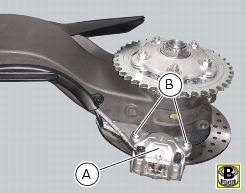
Remove the rear brake calliper (A) by unscrewing the two screws (B).
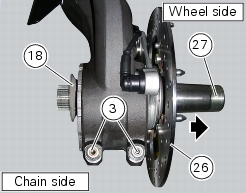
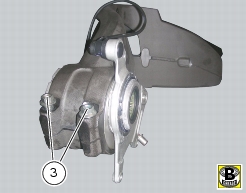
Slacken off the screws (3).
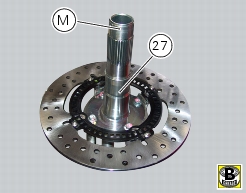
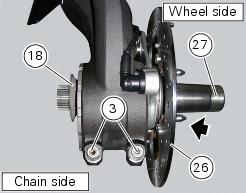
Withdraw the spacer (18) on the chain side and withdraw the wheel shaft (27) complete with brake disc (26) from the opposite side.
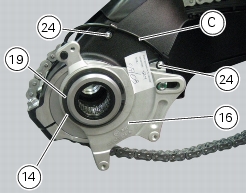
Remove the circlip (19) on the wheel side of the eccentric hub.
Loosen screws (24) and take the speed sensor cable (C) off the swingarm.
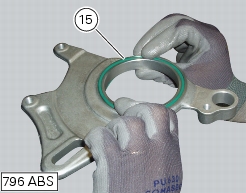
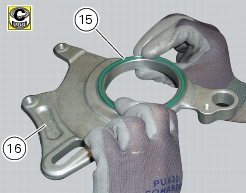
Remove the washer (14) and the calliper mounting bracket (16) with the two O-rings (15).
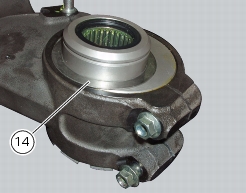
Remove the other washer (14).
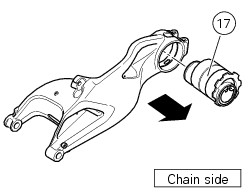
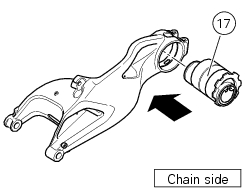
Withdraw the eccentric hub (17) from the chain side of the swingarm.
Note
The rear hub is a component particularly critical to the dynamic safety of the motorcycle. under no circumstances may the internal components of the hub be serviced or repaired. The hub may be ordered as a complete assembly, spare part No. 756.2.006.1A.
Removal of the rear brake disc
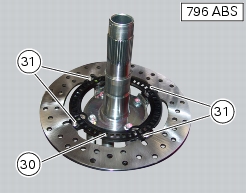
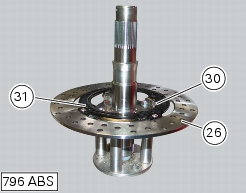
Unscrew the four screws (31) and remove the phonic wheel (30).
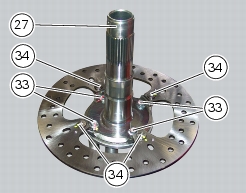
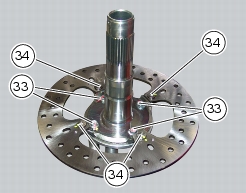
Undo and remove the four fixing screws (34) of the brake disc to the wheel shaft and remove the rear brake disc (26).
If they are to be renewed, undo the screws (33) from the wheel shaft (27) and remove the locating pins (32).
The brake disc must be perfectly clean, with no rust, oil, grease or other dirt and no deep scoring.
To check the wear limit of the brake disc refer to Sect. 3 - 1.1, Hydraulic brakes.
Refitting the rear brake disc
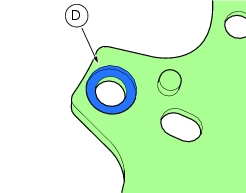
Position the brake disc (26) with the screw head seats (D) upward, as shown in the figure.
Reassemble the rear brake disc (26) tightening the screws (34) to a torque of 25 Nm ±5% and (33) to a torque of 5 Nm ±10% (Sect. C 3, Frame torque settings).
Fit the phonic wheel (30) and fasten it by tightening the screws (31) to the specified torque (Sect. C 3, Frame torque settings).
 
 
Refitting the rear wheel eccentric hub and rear wheel shaft
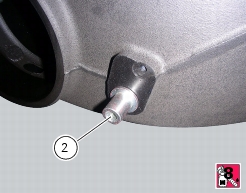
If the calliper bracket locating pin (2) was removed during disassembly, apply the recommended threadlocker upon reassembly, fit it on the swinging arm and tighten to a torque of 33 Nm ±5% (Sect. 3 - 3, Frame torque settings).
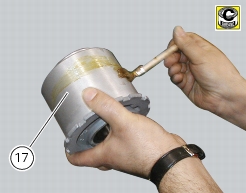
Before refitting, apply the recommended grease on the seat of the eccentric hub (17) on the calliper mounting bracket (16) on which the rings (15), also greased, will be installed.
Fit the eccentric hub (17) fully home in its housing on swinging arm.
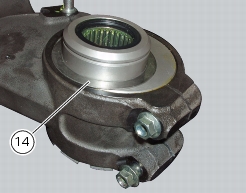
Fit the first washer (14) on the eccentric hub.
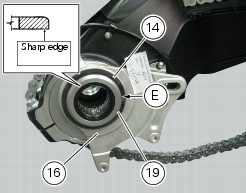
Position the calliper mounting bracket (16) setting it as shown in the figure.
Refit the other washer (14) and tighten the calliper mounting bracket (16) after installing circlip (19) in its groove (E) on hub, and setting it with its cutting edge outward.
Smear screws (3) with recommended grease and do them finger-tight without fully tightening.
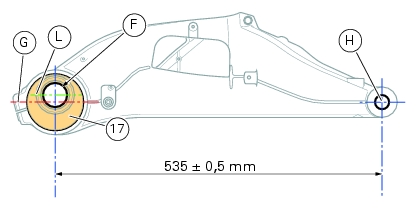
Turn the eccentric hub (17) taking the horizontal axis (L) of hub hole (F) above the horizontal axis (G) of hub seat and at any rate until achieving the correct centre distance between hub hole (F) and swingarm pivot hole (H), as shown.
Evenly apply the recommended grease to the thread (M) of the pin (27).
Fit the rear wheel shaft (27) to hub fully home.
Fit the inner bush (18) on wheel shaft (27), and position it so as the taper end is facing the shaft, as shown, then tighten the screws (3) to a torque of 31 Nm ±5% (Sect. 3 - 3, Frame torque settings) according to a 1-2-1 sequence.
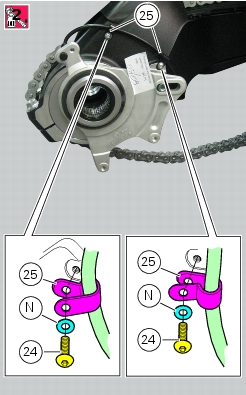
Route the speed sensor cable inside the two hose clips (25).
Smear the thread of the two screws (24) with recommended threadlocker and fit two washers (N) in-between.
Fasten hose clips (25) to swing arm, setting them as illustrated in the figure and then tighten the screws (24) to a torque of 1 Nm ±10% (Sect. 3 - 3, Frame torque settings).
Fit the rear brake calliper (A) over the brake disc, aligning it with the holes in the calliper mounting bracket. Grease the threads and undersides of the heads of the screws (B). Tighten the screws (B) to a torque of 25 Nm ±5% (Sect. 3 - 3, Frame torque settings).
 
Removal of the swingarm
Before removing the parts in question, you must first carry out the following operations:
 
Remove the rear wheel eccentric hub as described in chapter “Removal of the rear wheel eccentric hub and rear wheel shaft” of this section.
 
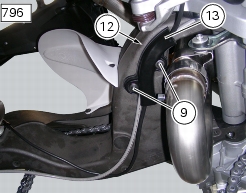
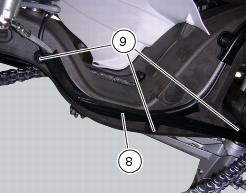
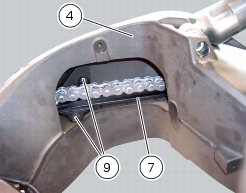
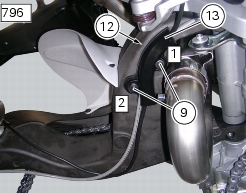
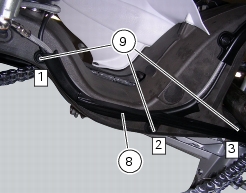
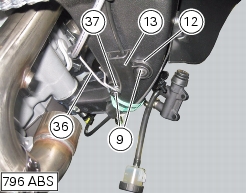
Free the rear brake hose and the speed sensor wiring from the lower chain slider (8) and from the upper protection (13) and lower protection (12) by unscrewing the screws (9).
Note
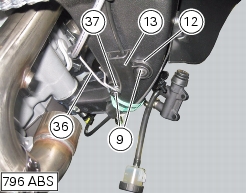
In the ABS version recover the hose clip (36) and the spacer (37).
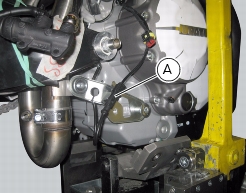
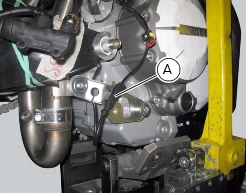
Disconnect the speed sensor wiring connector (A) from the main wiring loom.
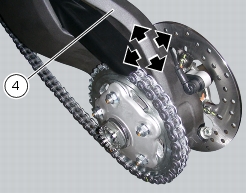
You can check the play in the swingarm bearings while the swingarm (4) still installed on the motorcycle frame
Grasp the rear of the swingarm (4) and try to move it in the four directions shown by the arrows.
Any abnormal movement is a sign of worn bearings that could cause instability when riding.
To check the free play of the support bearings, refer to Sect. 7 - 1, Overhauling the front wheel bearings.
Once the play in the swingarm bearings has been checked, the swingarm (4) may be removed from the motorcycle.
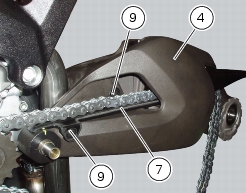
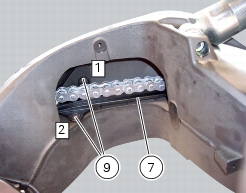
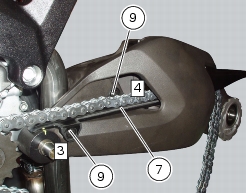
Undo and remove the screws (9) to remove the upper chain slider (7) from the swingarm (4).
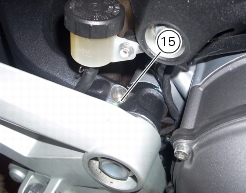
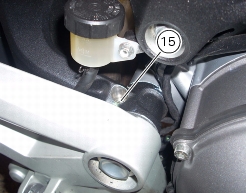
Hold nut (16) and tighten the screw (15) on swingarm pivot right-hand side.
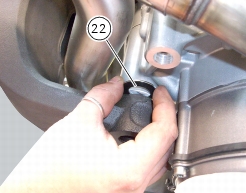
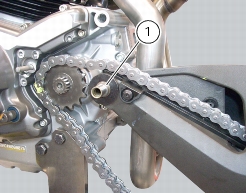
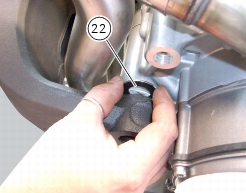
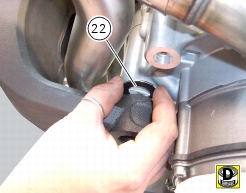
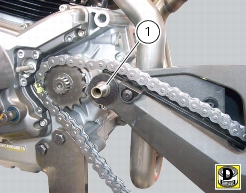
Remove the swingarm pivot (1) using a suitable tool, keeping the shimming washers (22) on either side of the swingarm.
Inspecting the swingarm pivot
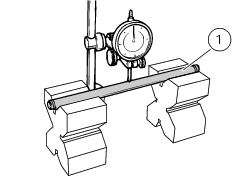
Measure the swingarm pivot shaft (1) runout using a dial gauge:
-
-
-
Service limit: (0.3 mm) (Sect. 3 - 1.1, Rear wheel).
Renew the pivot shaft when distortion exceeds the specified limit or if cracked or otherwise damaged.
Checking swingarm end float
The shim thickness (22) is to be determined on refitting the swingarm.
Check the end float as follows:
-
insert a 1.8 mm shim (22) on either side of the engine;
-
hold the left arm of swingarm (8) against the engine and measure the clearance on the other side of engine using a feeler gauge or calibrated shims.
The maximum permissible end float is 0.1 mm.
When a 0.10 mm feeler gauge or shim can only be inserted with difficulty, there is no need to install any further shims. Otherwise, use the two available shim sizes (0.20 mm and 0.10 mm) to obtain the specified end float.
 
Example:
 
Important
The thicker of the two shim packs must always be installed on the right-hand side of the swingarm.
 
The thinnest shim should always be installed so that it is contact with the swingarm.
NEVER install 0.1 mm shims on the left-hands side.
The left-hand side shim pack shall be max. 2 mm thick (1.8+0.2 max.).
Side-to-side movement of the rear end of the swingarm must be below 1 mm.
Refitting the swingarm
Smear grease on either side of shim (22) selected when checking the end float (see paragraph “Checking swingarm end float” in this section). Fit swingarm to engine with the selected shim (22) on the right-hand side.
Fit shaft (1) (duly greased) on the left-hand side and insert it by half its length.
Push the left arm of swingarm against engine and fit between the right arm and the engine the shim thickness (22) determined after measuring the end float.
Fully fit shaft (1), paying attention not to damage shims (22).
Tighten the screw (15) to a torque of 18 Nm ±5% (Sect. 3 - 3, Frame torque settings), while holding the nut (16).
Refit the upper chain slider (7) to the swingarm starting the screws (9) in their thread.
Tighten the screws (9) to a torque of 5 Nm ±10% (Sect. 3 - 3, Frame torque settings) in the mentioned sequence.
Fasten the rear brake hose and the speed sensor wiring to swingarm (4) installing the lower chain slider (8), the upper protection (13) and lower protection (12), and starting the screws (9) in their thread.
 
Tighten the screws (9) to a torque of 5 Nm ±10% (Sect. 3 - 3, Frame torque settings) in the mentioned sequence.
 
Note
In the ABS version place the hose clip (36) and the spacer (37) as shown in the figure.
Note
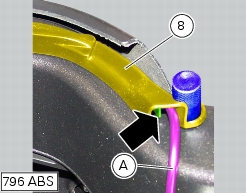
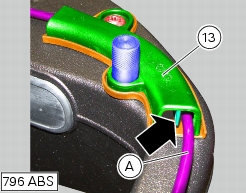
In the ABS version make sure that the speed sensor cable (A) is placed to the “right“ of the rib present inside the chain slider (8) or (13), as shown in the figure.
 
Connect the speed sensor wiring connector (A) to the main wiring loom.