4 -
1
2
3
4
5
6
7
8
9
10
11
12
13
14
15
16
17
18
19
20
21
22
23
24
25
26
27
28
29
30
 Spare parts catalogue
Important
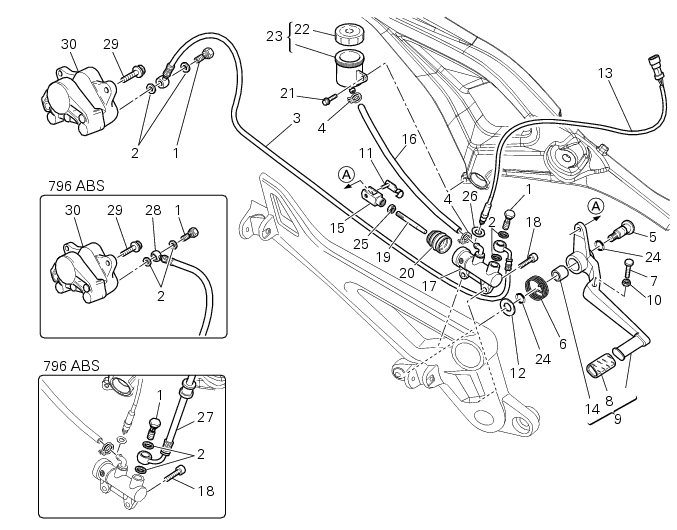
Bold reference numbers in this section identify parts not shown in the figures alongside the text, but which can be found in the exploded view diagram.
Removal of the rear brake lever
Warning
The brake master cylinder manufacturer advises against servicing the brake master cylinder due to the safety critical nature of this component. Incorrect overhaul of this component could endanger rider safety.
 
Maintenance operations on these units are limited to replacing the following parts: control lever, reservoir unit, reservoir fasteners and master cylinder fasteners.
 
Note
For the ABS front braking system, also refer to Sect. 7 - 5, ABS system operating information, Sect. 7 - 6, System components, Sect. 7 - 7, ABS components maintenance.
 
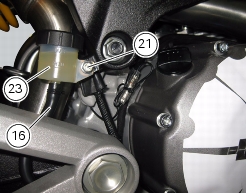
Undo the screw (21) and remove the reservoir (23) complete with the hose (16).
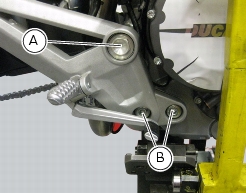
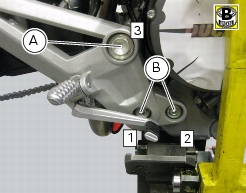
Unscrew the upper screw (A) securing the RH bracket to the swingarm.
Remove the washer between the bracket and the frame.
Unscrew the lower retaining screws (B) from crankcase.
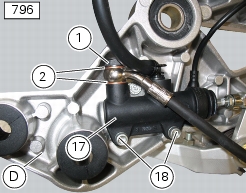
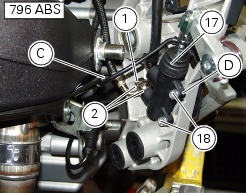
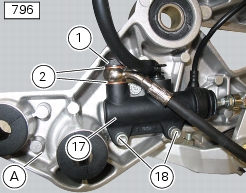
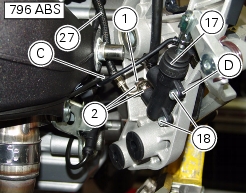
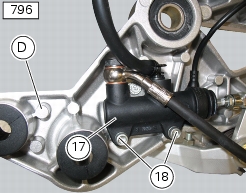
Unscrew the screws (18) securing the rear brake master cylinder (17) to the footrest bracket (D).
Unscrew the banjo bolt (1) from the master cylinder (17), recovering the two sealing washers (2).
Remove the clamp (C).
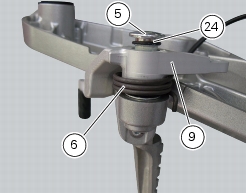
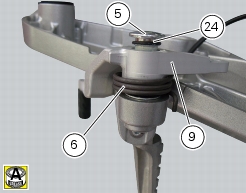
Unscrew the pin (5) securing the rear brake pedal lever to the footrest bracket and remove the spring (6), the complete pedal lever (9) and the O-ring (24).
 
Disassembly of the rear brake control
The brake master cylinder is supplied only as a complete unit; internal components cannot be replaced.
To disassemble master cylinder external components, follow the indications given in the exploded view at the beginning of this section.
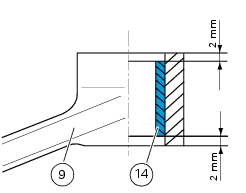
If the brake pedal (9) inner bushing (14) needs to be renewed, fit the new bushing using a suitable press and position it so that it is set in 2 mm from the outer face of the pedal.
To disassemble the various parts of the system, refer to the exploded view at the beginning of this chapter.
Warning
After performing an operation on the rear brake control, check the brake pedal position following the instructions detailed in Sect. 4 - 3, Adjusting the position of the gear change and rear brake pedals.
Refitting the rear brake control
Lubricate the O-ring (24) and install it on the pin (5).
Lubricate also the other O-ring (24).
Fit the spring (6) and the rotation pivot pin (5) to the footrest bracket, pushing the pivot pin fully home and positioning the spring (6) as shown in the figure.
Apply threadlocker to the threads of the pivot pin (5).
Locate the line connecting rear brake master cylinder - ABS control unit (27) (796 ABS) or the pipe (3) (796) and washers (2) on the rear brake master cylinder (17) and fix it with the special screw (1).
Note
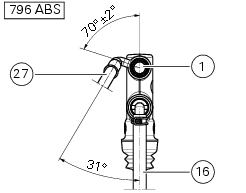
If the hose connecting the rear master cylinder to the ABS control unit (27) and the one connecting master cylinder and reservoir (16) are changed, ensure that the hose end fittings on master cylinder are positioned correctly.
 
Orientate the hoses (3) and (16) as illustrated in the figure and then tighten the screw (1) to a torque of 23 Nm ±10%
(Sect. 3 - 3, Frame torque settings).
If the pushrod (19), clip (11) and fork (15) assembly has been dismantled, reassemble by screwing the nut (25) onto the pushrod (19) and then screw the pushrod into the clevis (15) to obtain the measurement indicated in the figure.
Restrain the pushrod and tighten the nut (25) against fork (15) to a torque of 7.5 Nm ±10% (Sect. 3 - 3, Frame torque settings).
Position the rear brake master cylinder (17) onto the footrest bracket (D) then start screws (18) in their thread.
Tighten the retaining screws (18) to a torque of 23 Nm ±10% (Sect. 3 - 3, Frame torque settings).
Fit the rear brake control rod on the pivot bolt (9), securing it with the clip (11).
Now lubricate the other end of the pushrod (19) with the recommended grease and insert it in the master cylinder (1).
Refit the clamp (C).
Set the washer in-between the RH footrest bracket and the frame.
Fasten the right-hand side footrest bracket to the swinging arm using the screw (A), duly lubricated, and to engine using screws (B). Tighten the screws (A) to a torque of 55 Nm ± 5% and the screws (B) to a torque of 36 Nm ±10% (Sect. 3 - 3, Frame torque settings) in the mentioned sequence.
 
Removal of the rear brake calliper
Important
The brake master cylinder manufacturer advises against servicing the brake master cylinder due to the safety critical nature of this component. Incorrect overhaul of this component could endanger rider safety.
 
Operations should be limited to renewal of the pads, fasteners and the bleed valve assembly.
 
Note
For the ABS front braking system, also refer to Sect. 7 - 5, ABS system operating information, Sect. 7 - 6, System components, Sect. 7 - 7, ABS components maintenance.
 
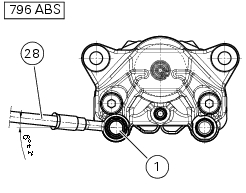
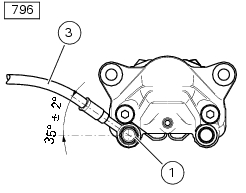
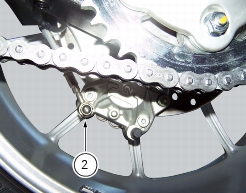
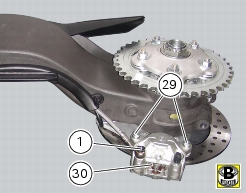
Unscrew and remove the special screw (1) securing the hose to the rear brake calliper and recover the sealing washers (2).
Note
Keep a cloth at hand to wipe up any brake fluid that leaks out of the hose.
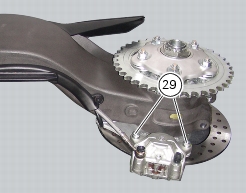
Undo the screws (5) securing the rear brake calliper (29) to the calliper mounting bracket and remove the calliper.
Note
To replace the brake pads, please refer to Sect. 4 - 3, Checking brake pad wear and changing brake pads.
 
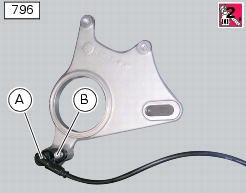
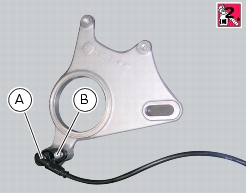
To remove the speed sensor (A), loosen the screw (B) securing it to the calliper mounting bracket, taking care not to damage the spacer.
Only the following parts should be renewed:
brake calliper: pads, fasteners and bleed valve assembly;
master cylinder: control pedal, bleed valve assembly, reservoir and its components.
 
Refer to the exploded view at the beginning of this section for indications on renewal of the above components.
 
To replace the speed wheel sensor (796 ABS) please refer to section 7-6 “Replacing the rear phonic wheel sensor“.
Refitting the rear brake calliper
When replacing the brake lines or removing one of the rear braking system components, pay special attention to the position of the couplings on the master cylinder, callipers and control unit.
Warning
If incorrectly positioned, the hose can affect brake operation and foul moving parts.
If the speed sensor (A) was removed, fit it on the calliper holder bracket with the spacer and tighten the screw (B) to a torque of 1 Nm ± 10% (Sect. 3 - 3, Frame torque settings).
Fit the copper sealing washers (2) to either side of the hose end fitting when connecting the brake hose to the brake calliper. Orientate the end fittings of the hose (6) on the calliper as shown in the photo.
Tighten the special screws (1) to a torque of 23 Nm ±10% (Sect. 3 - 3, Frame torque settings).
Fit the rear brake calliper (30) over the brake disc, aligning it with the holes in the calliper mounting bracket. Grease the threads and undersides of the heads of the screws (29). Tighten the screws (29) to a torque of 25 Nm ± 5% (Sect. 3 - 3, Frame torque settings).
Note
The gap between the sensor (A) and the brake disc fixing screw (B) must be within 0.6 to 2.2 mm.