6.1 -
1
2
3
4
5
6
7
8
9
10
11
12
13
 Spare parts catalogue
Important
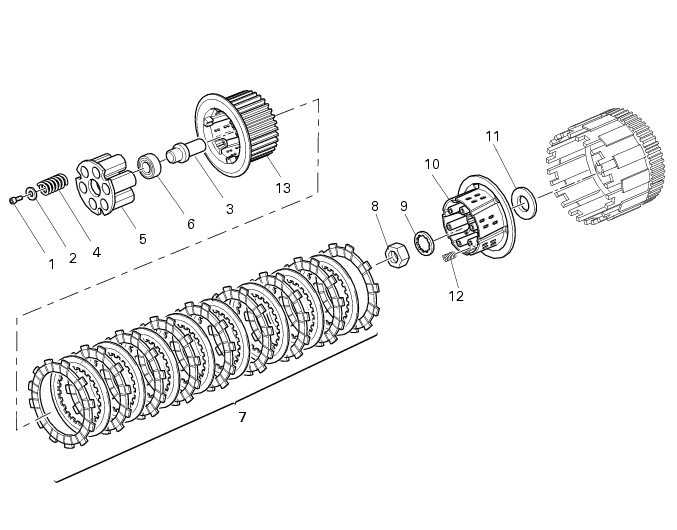
Bold reference numbers in this section identify parts not shown in the figures alongside the text, but which can be found in the exploded view diagram.
Description of the APTC clutch assembly
The APTC system with servo-assisted torque and anti-wheel slip on braking.
The advantages of this system are:
-
-
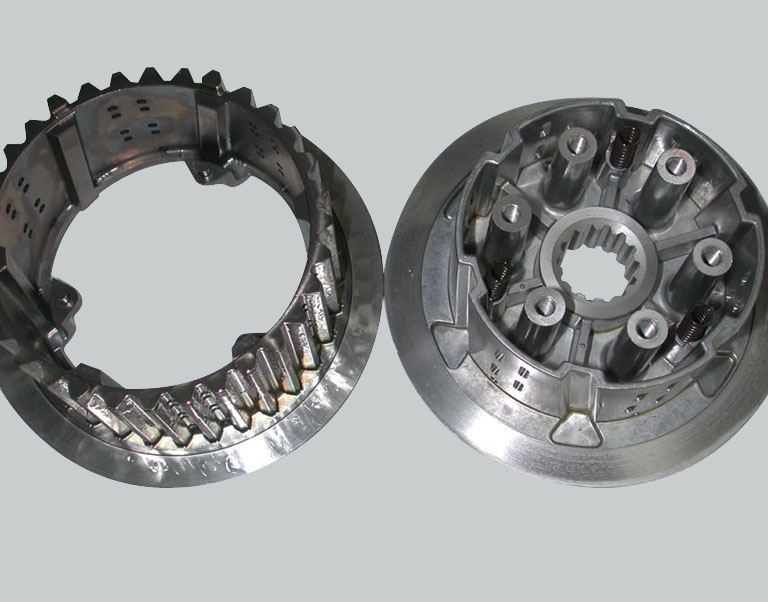
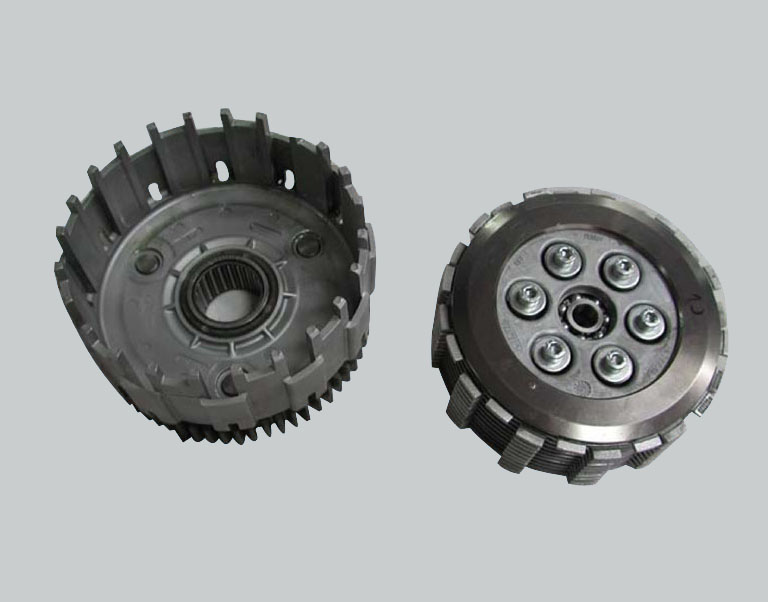
The APTC system consists essentially of a splined coupling between the two parts of the clutch drum.
This coupling exploits the axial component of driving torque (bike accelerating) or reverse-acting torque (clutch disengaged) to produce servo-assistance in the former case and prevent rear wheel slip in the latter.
In practice, this means that under acceleration (and thus with driving torque) the clutch pack will tend to be under a greater load (from springs initially more loaded), while during hard downshifting, the reverse-acting torque will tend to take load off the springs thus causing the plates to slip.
Before working on the internal clutch parts, check that the clutch operates correctly. Then deal with the problem in a systematic manner.
The following is a list of possible causes of clutch malfunctions.
A clutch which does not disengage may be caused by:
-
-
-
-
-
 
A clutch which slips may be caused by:
-
-
-
-
-
 
A noisy clutch may be caused by:
-
-
-
-
-
Removal of the APTC clutch
 
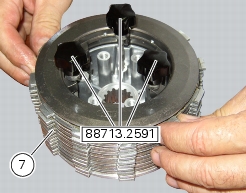
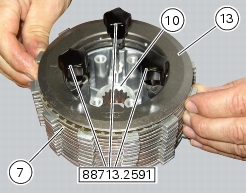
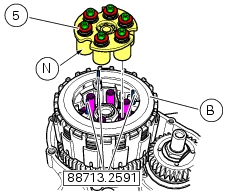
Screw the three tools 88713.2591 into the relative bores in the hub.
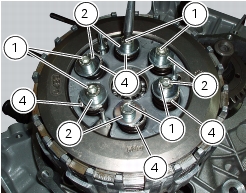
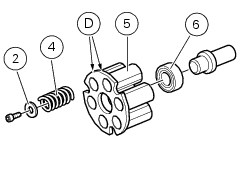
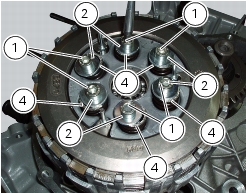
Unscrew the retaining screws (1) and remove the collars (2) and the clutch springs (4).
Remove the pressure plate (5) with the clutch control pin (3). If necessary, using a drift of suitable diameter, remove the bearing (6) installed on the inner side of the pressure plate (5).
 
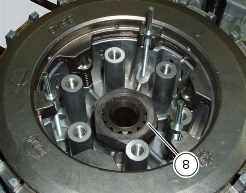
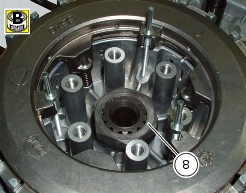
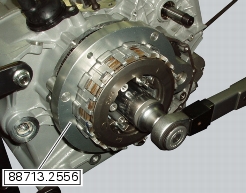
Hold the clutch drum with the service tool part no. 88713.2556 and unscrew the fastening nut (8).
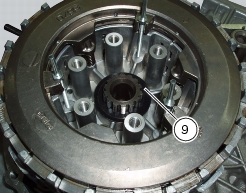
Remove the washer (9).
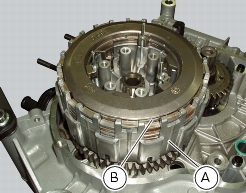
Withdraw the clutch hub-plates-centre assembly (B) from the clutch drum (A), marking the components so as to be able to install them in the same position.
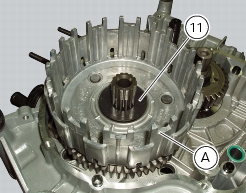
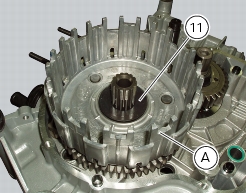
Remove the spacer (11) from the clutch drum (A).
Disassembly of the clutch hub-plates-centre assembly
Unscrew the three tools 88713.2591.
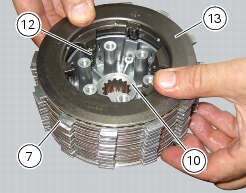
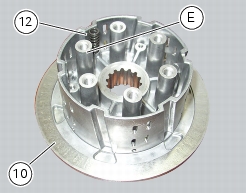
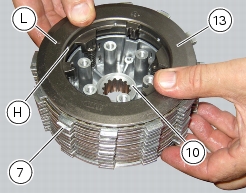
Withdraw the hub (13) and the plates (7) from the clutch centre (10). Recover the three springs (12).
Remove the clutch plates (7) from the hub (13).
Important
When removing the plates, keep them in the same order as they were originally installed, tying them together if necessary.
Overhaul and inspection of the APTC clutch components
Clearance between the clutch drum and friction plates
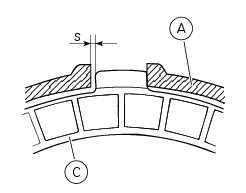
Insert a friction plate (C) in the clutch drum (A) and measure the clearance (S) with a feeler gauge.
Clearance “S” must not exceed 0.6 mm.
If it does, renew the plates and, if necessary, the clutch drum.
Overhaul of the clutch plates
The clutch plates must not show any signs of blackening, grooves or deformation.
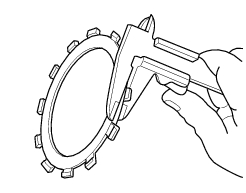
Measure the thickness of the friction plates. It should not be less than 3.2 mm.
Important
The total thickness of the clutch plate pack must not be less than 50.2 mm.
 
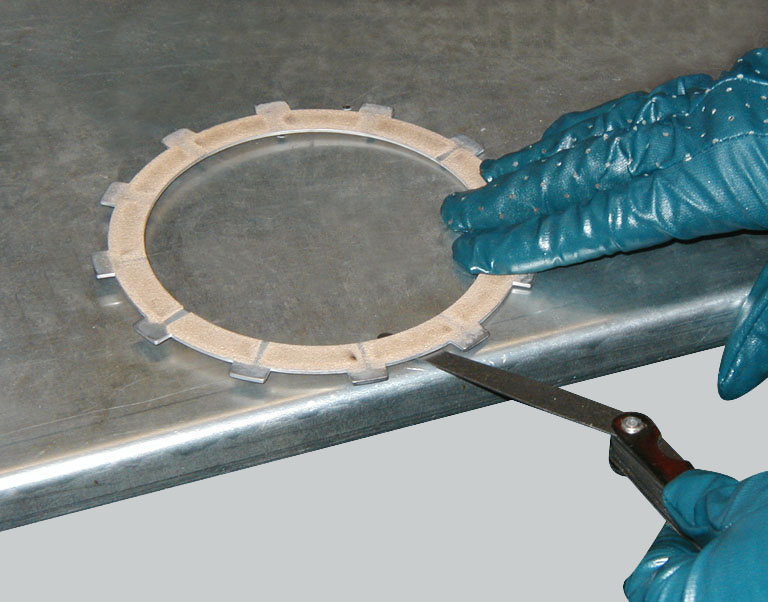
Place the plate on a flat surface and check the amount of deformation with a feeler gauge.
Max flatness error: 0.2 mm.
Overhaul of the pressure plate
Check the condition of bearing (6): renew the bearing if the play is excessive.
Check the contact surfaces of the last friction plate; if excessively scored, use a reference plate and diamond lapping paste (6‑12 microns thick) and rub the friction plate on it to obtain a smooth, uniform surface.
Check the condition of the spring guide cups (D) of the pressure plate (5) and always replace the spring retainer caps (2) at each overhaul.
Overhauling the pressure plate springs
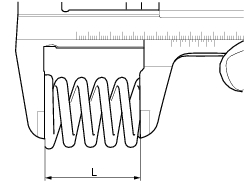
Measure the length “L” of each spring (4):
-
Renew any springs that are shorter than the above limit value.
Reassembly of the clutch hub-plates-centre assembly
Install the three springs (12) on the pin (E) on the drum (10).
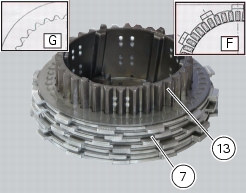
Install the clutch plates (7) in the hub (13) starting with one of the 11 friction plates (F) and alternate with the 10 driven plates (G).
Install the clutch plate assembly (7) with hub (13) in the drum (10).
Warning
When refitting the clutch centre (10) with the hub (13), align the reference notches (H) and (L).
Insert the three tools 88713.2591 to fix the hub (13) to the clutch centre (10).
Screw in the three tools 88713.2591 by hand, pressing down on the clutch plates with the hub (13), so as to overcome the resistance of the springs.
Note
Screw in the three tools 88713.2591 to put the clutch plates under a light load.
Refitting the APTC clutch
Locate the spacer (11) on the drum (A).
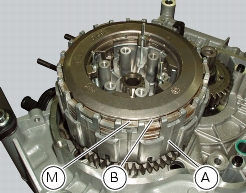
Position the hub-plates-drum assembly (B) inside the drum (A).
Note
Place the last clutch plate (M) offset with respect to the others.
Locate the lock washer (9) on the primary shaft, seating it against the clutch assembly.
Apply the recommended grease to the contact face of the nut (8) and to thread of the primary shaft, then fit the nut to the input shaft and tighten by hand.
Restrain the clutch drum with tool part no. 88713.2556 when tightening nut (8).
Tighten the nut (8) to a torque of 190 Nm (Min. 180 Nm - Max. 200 Nm) (Sect. 3 - 3, Engine torque settings).
Remove service tool no. 88713.2556.
Install the pressure plate (5) on the clutch assembly (B) aligning the three tools 88713.2591 with the three indents (N) in the pressure plate.
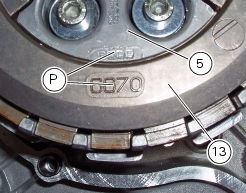
Check that the two codes (P) stamped on the hub (13) and the pressure plate (5) are aligned.
In each cavity, fit a spring (4) and a cap (2).
Tighten the screws (1) to a torque of 10 Nm (Min. 9 Nm - Max. 11 Nm) (Sect. 3 - 3, Engine torque settings) in a crosswise sequence.
Unscrew and remove the service tools 88713.2591.