3 -
1
2
3
4
5
6
7
8
9
10
11
12
13
14
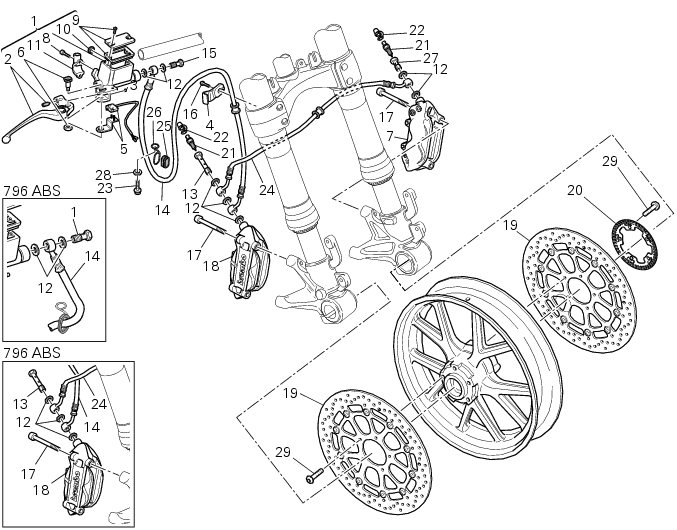
Callipers–master cylinder hose
15
16
17
18
19
20
21
22
23
24
25
26
27
28
29
 Spare parts catalogue
Important
Bold reference numbers in this section identify parts not shown in the figures alongside the text, but which can be found in the exploded view diagram.
Removal of the front brake master cylinder
Warning
The brake master cylinder manufacturer advises against servicing the brake master cylinder due to the safety critical nature of this component. Incorrect overhaul of these critical safety components can endanger rider and passenger safety.
Maintenance operations on these units are limited to replacing the following parts: control lever, reservoir unit, reservoir fasteners and master cylinder fasteners.
 
Note
For the ABS front braking system, also refer to Sect. 7 - 5, ABS system operating information, Sect. 7 - 6, System components, Sect. 7 - 7, ABS components maintenance.
 
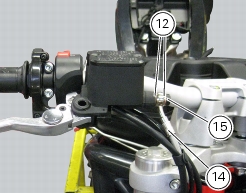
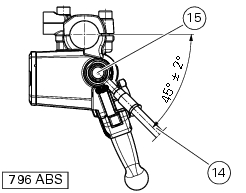
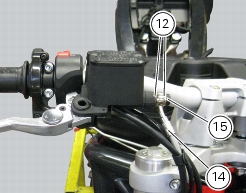
Unscrew the special screw (15) securing the brake hose to the master cylinder and recover the sealing washers (12); slide hose (14) out of front master cylinder.
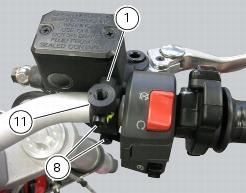
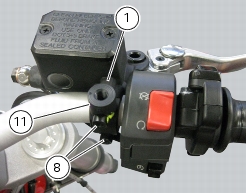
Loosen the screws (8) securing the mounting U-bolt (11) and then remove the front brake master cylinder assembly (1) from the handlebar.
For disassembly of components of the master cylinder assembly (1), refer to the exploded view at the beginning of this chapter.
Refitting the front brake master cylinder
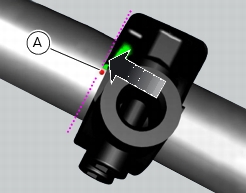
Insert the front brake master cylinder unit (1) on the right side of the handlebar to bring the terminal internal edge in correspondence to the bolted joints (A).
Refit the U-bolt (11) on the handlebar and insert the screws (8).
Locate the pipe (14) and the gaskets (12) on the master cylinder unit (1) and secure with the special screw (15), but do not tighten at this stage.
Tighten the retaining screws (11) to a torque of 10 Nm ±10% (Sect. 3 - 3, Frame torque settings) in the sequence 1-2-1 starting from the upper screw.
 
Warning
If incorrectly positioned, the hose can affect brake operation and foul moving parts.
 
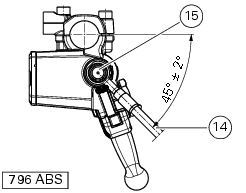
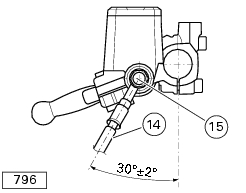
Orientate the pipe (14) as illustrated in the figure and then tighten the special screw (15) to a torque of 23 Nm ± 10 %
(Sect. 3 - 3, Frame torque settings).
 
 
Maintenance operations
Warning
Brake fluid is corrosive and will damage paintwork. Avoid contact with eyes and skin. In case of accidental contact, wash the affected area with abundant running water and consult a doctor if necessary.
 
For all the maintenance operations (wear check and replacement of brake pads and brake fluids, etc.) see Sect.  4 - 3, Maintenance operations.
Removal of the front brake system
Note
For the ABS front braking system, also refer to Sect. 7 - 5, ABS system operating information, Sect. 7 - 6, System components, Sect. 7 - 7, ABS components maintenance.
 
 
Unscrew the special screw (15) securing the brake hose to the master cylinder and recover the sealing washers (12); slide hose (14) out of front master cylinder.
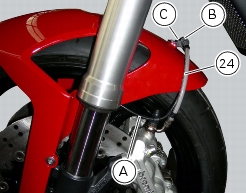
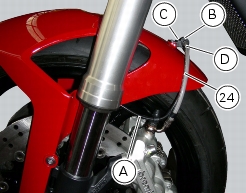
Loosen screw (C) to remove front brake hose (24) and the ABS sensor cable (A) from hose clip (B).
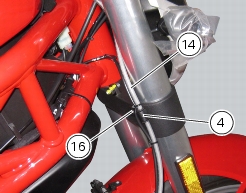
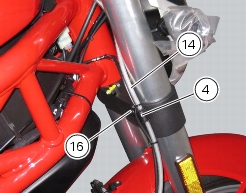
Loosen the screw (16) and slide the pipe (14) from the bracket (4) on the bottom yoke.
Warning
While removing the front brake hose, if you damage the hose clip (B) you shall renew it (Sect. 5 - 4, Removal of the front mudguard).
 
If hose is not fastened by hose clip (B), it might interfere with tyre under braking and provoke accidents.
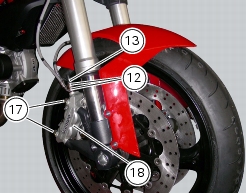
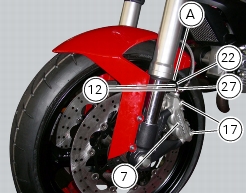
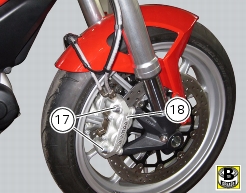
Loosen the two retaining screws (17) securing the left front brake calliper (7) to the fork leg.
Repeat the operation for the right brake calliper (18).
Free ABS sensor cable (A) from the dust seal (22) on front left-hand brake calliper (7).
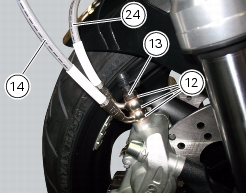
Loosen the special screws (13) and (27) and recover the sealing washers (12) from both callipers.
Separate the front brake callipers from the brake pipes.
Note
For correct position of the ties fastening the ABS sensor cable (A) to front brake lines, please refer to Sect. 7 - 6, Flexible wiring/hoses positioning.
Removal of the brake discs
 
 
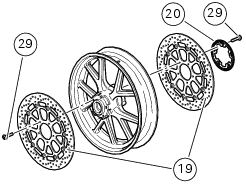
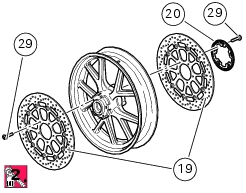
The front brake discs consist of an inner carrier, which is mounted to the wheel, and an outer rotor. Both parts must be changed together as a pair.
 
Loosen the fixing screws (29) of the disc to the wheel, remove the disc (30) and in the ABS version, on its left side, slide out the phonic wheel (20).
Overhauling the front brake components
Important
Critical safety components. The manufacturer of the brake calliper advises against servicing the internal components of callipers. Incorrect overhaul of this component could endanger rider safety.
 
Maintenance operations on these units are limited to replacing the following parts: pads, fasteners and bleed valve assembly.
Refer to the exploded view at the beginning of this section for indications on renewal of the above components.
The brake disc must be clean without any signs of rust, oil, grease or dirt and no deep scoring.
To check brake disc wear, refer to the service limits given in the paragraph “Hydraulic brakes“ (Sect. 3 - 1.1).
Refitting the brake discs
Before refitting the brake disc to the wheel, clean all contact surfaces thoroughly and smear a medium strength threadlocker on the threads of retaining screws (29).
In the ABS version, operate on the left side to fit the phonic wheel (20).
Tighten the screws (29) securing the front brake disc (19) to the front wheel in the sequence: 1-3-5-2-4.
Tighten the retaining screws (29) to a torque of 25 Nm 5% (Sect. 3 - 3, Frame torque settings).
 
Refitting the front brake system
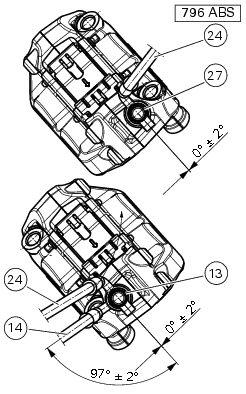
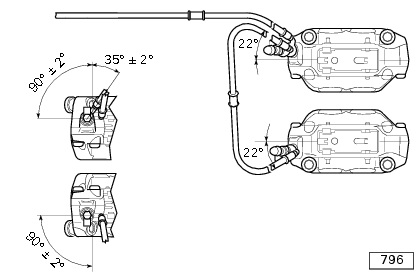
When refitting the system, pay attention to the orientation of the couplings of the hoses (14) and (24).
 
 
Warning
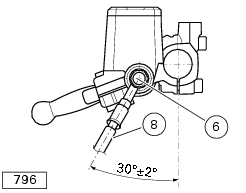
If incorrectly positioned, the hose can affect brake operation and foul moving parts. Position the hose as shown in the figure.
 
When reconnecting the brake hose to the calliper or master cylinder, make sure to install the sealing washers (12) either side of the hose end fitting.
After orientating the coupling, lock the special screw (15) to a torque of 23 Nm ±10% (Sect. 3 - 3, Frame torque settings).
Reconnect the hoses (14) and (24) to the front brake callipers (7) and (18) and tighten the screws (13) and (27) to a torque of 23 Nm ±10% (Sect. 3 - 3, Frame torque settings).
Note
Make sure that internal pipe coupling (14) and the external pipe coupling (24) are installed in the right brake calliper (18).
Fit the RH calliper (18) over the disc.
Apply the recommended grease to the screws (17).
Hand tighten the bolts (17) to secure the callipers to the fork legs.
Tighten the screws initially to a torque of 2 Nm ±10% (Sect. 3 - 3, Frame torque settings).
Repeat the operation for the left brake calliper (7).
 
Operate the front brake lever two or three times until the circuit is pressurised and force the pads against the brake disc.
Hold the lever pulled in towards the grip and tighten the calliper screws (7) to a torque of 45 Nm ± 5% (Sect. 3 - 3, Frame torque settings).
Insert brake rubber block (D) into grommet (B) and ensure it is centred.
Fold hose clip (B) and fasten it by starting the screw (C) in its thread.
Insert hose (14) in bracket (4) and tighten screw (16) to a torque of 8 Nm ±10% (Sect. 3 - 3, Frame torque settings).
Note
For correct position of the ties fastening the ABS sensor cable (A) to front brake lines (24), please refer to Sect. 7 - 6, Flexible wiring/hoses positioning.